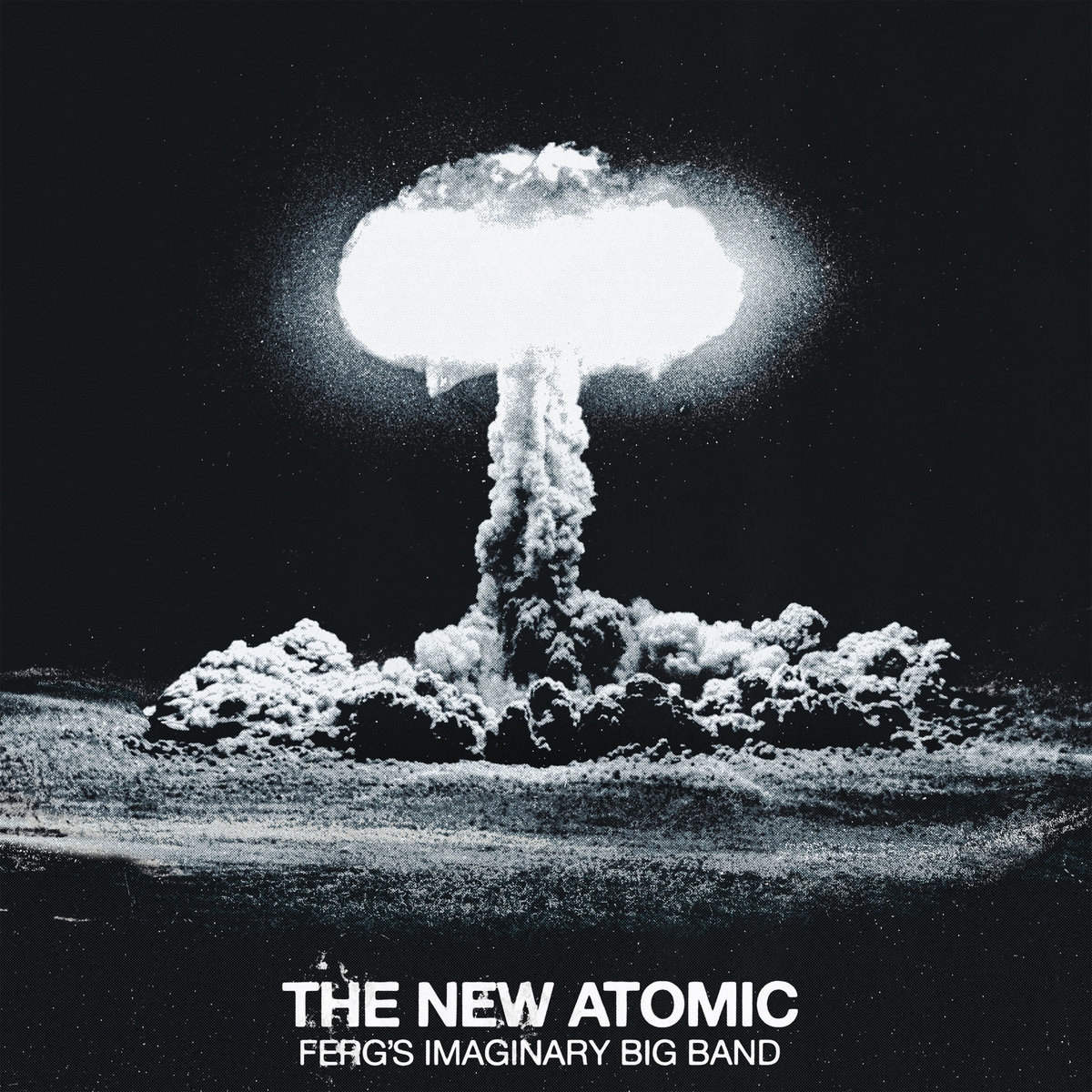
FERG’S IMAGINARY BIG BAND: The New Atomic (Trash City Records TCR/2026/006)
J Surfing On The Saturn/Theme From ‘The New Atomic’/Love Sick/Do The Right Thing/Playing The Names/Besszilla/Same Sky/I Shall Not Be Moved
Fergus Quill (MD, vocals, “various”); Dan Coulthurst, Emyr Penry Dance, Ernie Moore, Fee Buckton, Olivia Cuttill (trumpets); Felix Burling (trumpet, trombone, tuba); Sam Ehret’Pickett (trumpet, marching baritone horn); Aidan Ruffle, Benji Arnold, George Murray, Peter New, Adam Chard (trombones); Nat Martin (tenor horn); Flo Taylor, Saul Duff (alto saxes); Sophie Speed, Will Gibbon, Harvey Parkin-Christie (tenor saxes); Bess Shooter (baritone sax); Alex Fisher (bass and sopranino saxes); George MacDonald, Nico Widdowson (keyboards); Hamish Dixon (“noise”); Will Lakin (guitar); Connal Mulvenna (guitar, vocals); Joe Cross (guitar, bass, vocals); Aby Vulliamy (viola); Woody Hayden (bass); Josh Ketch, Theo Goss (drums); Jonathan Lodder (drums, percussion, vocals); Richard Moulton, “AJ” (percussion); “The Imaginettes” [Amy Clark, Sunday Lendis, Rebecca Herrington, Rosie Miles, Laura Kindelan] (vocals)
With extra “Spiritual Advice” credits to “Poppy” and “AJ,” there are over forty musicians present on the first full-length studio album by Ferg’s Imaginary Big Band, which by default makes this the most ambitious British big band since Centipede. Nominally steered by Fergus Quill but very much a democratic enterprise, these are all new names to me, which is hardly surprising since this band is based in Leeds (as is the Ancient Infinity Orchestra, which has a personnel overlap with FIBB).
Given that the city also boasts the likes of KOG, Plantfood and the Awen Ensemble – all of whom feed into FIBB’s arteries – as well as bands like Yard Act, it has obviously been beneficial for Leeds to develop its strongest musical scene in over forty years, since the days of Xero Slingsby and the Three Johns, completely out of the metropolitan radar. This is exciting and thrilling music which couldn’t have been imagined in London, where a generation of excellent improvisers have been corralled by plantation-eared A&R types into producing vacuous New Age comfort trifles.
FIBB also sound a good deal more fun than even Tippett’s most venerated large ensembles; as intermittently great as Septober Energy and Frames were – though both were far more dynamic when performed live (I was there at the Lyceum and the Roundhouse in November 1970 and May 1978 to witness) - neither can escape the impression of an austere extended church sermon.
Many names have already been banded about as influences on The New Atomic but on an overall couple of listens the names which leap out at me are two Michaels from the sixties – Gibbs and Mantler. Like Mike Gibbs, FIBB’s music tends to be emphatically rhythmic and melodic in nature – and like some of Gibbs’ records, the mixing does tend to favour the rhythm section and obscure the fine detail of what is going on elsewhere (e.g. the cop show theme gone slightly wrong “Do The Right Thing”). The brass and saxophone voicings, which tend to double up in agony or slide mournfully between bar lines, are highly reminiscent of what Mantler was doing with the Jazz Composer’s Orchestra in 1968.
But there really is no precedent for something like “J Surfing On The Saturn” (arranged by Sam Eastmond) which combines strong melodic and harmonic elements with rhythmic flexibility and a degree of unrest in the general ensemble. The initial theme statement leads to some fine alto playing from what sounds like Flo Taylor taking turns with Saul Duff – unfortunately my CD copy did not come with what Tippett routinely described as “a guide to enable identification of featured soloists,” and while I recognise the ensemble’s totality outweighs individual elements, ancient folk like myself still like to know who’s doing what. There follows a comparatively restrained dialogue for harpsichord and piano, before the main theme picks up again and leads to insolently explosive work from guitar(s) and an Eno-style wheedling random synthesiser which I presume represents Hamish Dixon’s “noise” before the piece concludes with large-scale free form freakouts, alternating with mordant pauses of quietude. There is a boldness at work here that has been absent from most British-based big band jazz of the last forty years or so – only Mike Westbrook’s Devon-based Uncommon Orchestra, Tippett’s Tapestry Orchestra and the various Improvisers’ Orchestras from London, Glasgow etc., veered towards this territory.
The album was apparently edited down from about five hours of music, recorded in the presence of an audience whose cheerful whoops rear their head now and again, and as with the first, eponymous Loose Tubes album really represents a “this is what we do” sampler. Other than a very obvious political subtext – “Theme From ‘The New Atomic’” and “I Shall Not Be Moved” are performed as Mantler might have arranged Charlie Haden’s Liberation Music Orchestra, although the furious and enraged drumming which climaxes the latter is very reminiscent of Laurie Allan’s onslaught in Robert Wyatt’s 1975 version of “Song For Ché,” while part of the proceeds from sales of this album will be donated to War Child – The New Atomic is, perhaps paradoxically, quite a relaxed album, given the eye of its intensity.
Some of the work here is simple and cautiously gleeful; the unintelligible vocal quarrel which thrusts us into the tumult of “Playing The Names” made me think of early Rip, Rig and Panic, while baritone player Bess Shooter has great fun doing her best Peter Brötzmann impression amidst corny B-movie trailer voiceovers and speed metal thrashouts on “Besszilla.” There are also two actual songs – a cover of Dylan’s “Love Sick,” sung by a singer whom I could not identify but who sounded stranded between Phil Minton and Kate Westbrook, and punctuated by plaintively ululating horn lines, put me in mind of no less a forgotten ensemble as Manfred Mann Chapter Three, the free jazz/fusion experiment which briefly flourished between the pop group and the Earth Band (and for whom Mike Gibbs also supplied arrangements).
Perhaps the record’s most surprising moment is “Same Sky,” a ballad, or possibly a photograph of a torch song, performed and arranged absolutely straight (and with patient elegance) by singer Amy Clark, who sounds rather like RAYE in places – let’s hope a copy of this record finds its way to her! But overall The New Atomic is possibly the most refreshing large-scale British jazz album in half a century – as with Tippett (and indeed Carla Bley and Westbrook – these form my holy trinity of musicians) the overwhelming urge is to make music together and become more powerful as a consequence of that combination, rather than to make A Point. It stands with Westbrook’s Release and the early Brotherhood of Breath in terms of unrepentant newness (and nowness). It must not be ignored or overlooked.


No comments:
Post a Comment